As an organization dedicated to supporting children and families in crisis, we recognize that holidays can be a delicate and nuanced time for many. In this series, Purposeful Perspectives, we asked our staff members to select a season, month, or day that is meaningful to them to share with our CASA community. Thank you for joining us as we take a deeper look behind the celebrations that fill our lives.
Black History Is My History
By Shauna McCullough-Hightower
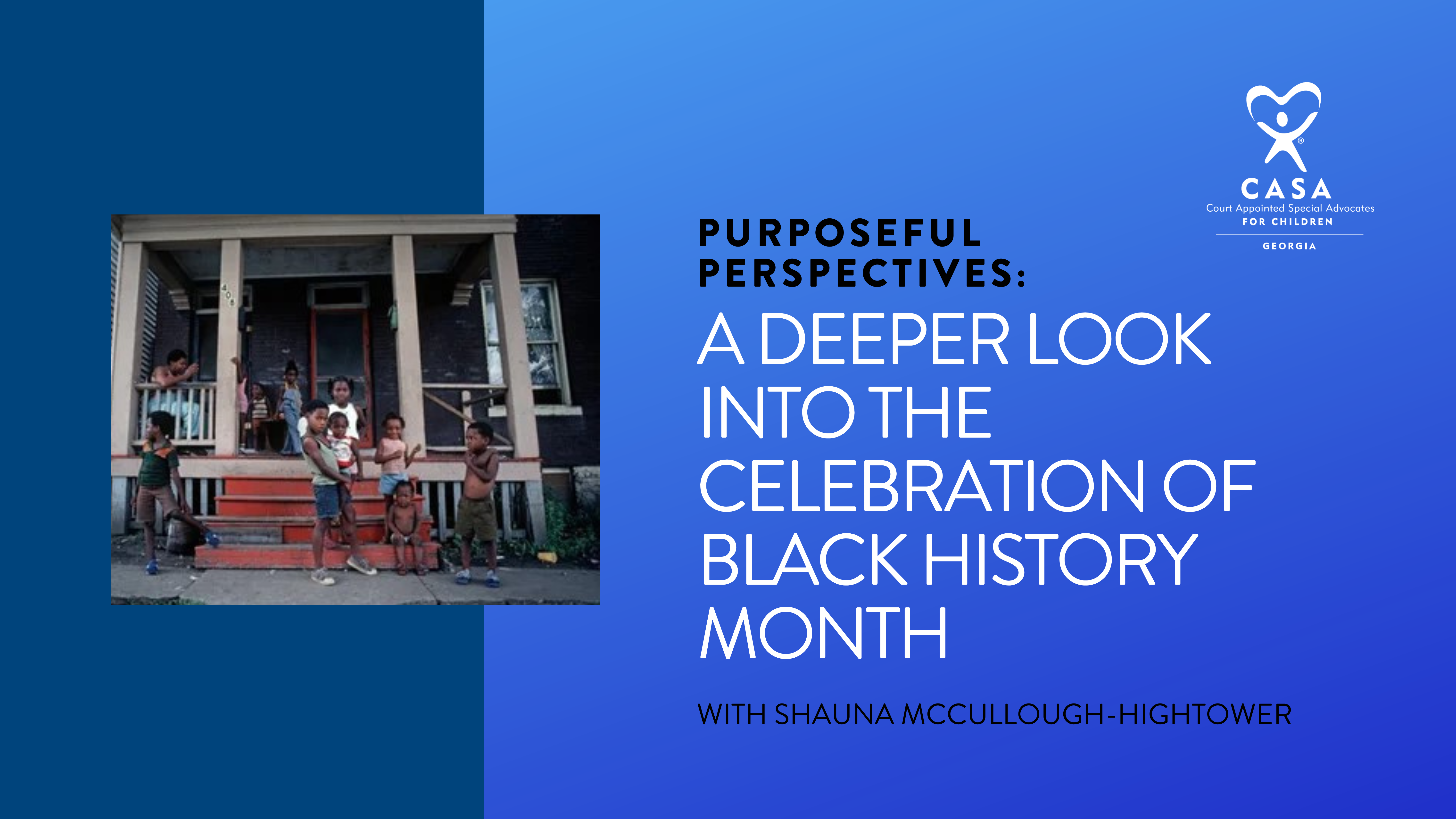
It was the summer of 1982; one of the joys of my 7-year-old life was going four blocks down to “The Ice-cream Lady’s” house with a shiny nickel in my hand to buy a cold treat. My only worry was which one, the frozen Kool-Aid pop or the homemade vanilla, would be my treat of the day. (It was homemade vanilla most of the time.)
All the kids in the neighborhood loved “The Ice-cream Lady.” To this day, I have no idea what her real name was. Our parents probably didn’t know we made the trek down to visit this unnamed woman as often as we did. Adults worked and supervision was a luxury we, and many other families like ours, couldn’t afford.
The summer belonged to us.
Though the idea of second graders wandering off alone day after day might raise some concerns, in my case there was a bigger picture to keep in mind. This was a Black Community, and for me, this meant that the neighborhood had eyes on me and my fellow summer adventurers. In this context, we felt safe.
We sometimes see that culturally accepted norms in Black Communities have been the reason children have been removed from their homes. Situations like mine are a call for services, not removal. I love that the CASA mission empowers us on the grassroots level to bring attention to cases like this and advocate for services and reunification. This underscores the importance for us as a network to remain committed to cultural competence through pre-service training, DEI workshops, personal development and education, and in-service training. We all should understand our biases and take a self-assessment of how we view these experiences, the resulting response, and whether we are viewing them through a culturally competent lens.
Black History is my history. It is what makes me who I am, who my children are, and how we came into being; it is our story, and it defines our culture. Black History Month invites those willing an introductory opportunity to learn about the lived experiences of Black People. This is crucial to keeping the big picture in mind and contextualizing the experiences of those we encounter, within and without of this work.
Featured Posts
Beyond the Courtroom: Advocating for a Child’s Educational Future
When Emily and her infant daughter entered foster care, they were placed with a relative. During the case investigation, I learned that Emily had not attended formal school since the third grade. Although her parents had provided an online educational program, there had been little follow-up to ensure she was making progress.
Purposeful Perspectives: Why Advocacy Is Personal for Me
For October's Purposeful Perspectives blog Executive Director of Dougherty County CASA, Charlene Maldonado, reflects on what October means to her.
Advocacy in Action: Seeing the Whole Family to Serve the Child
"One of the greatest rewards of being a CASA volunteer comes long after the court hearings have ended, and the case has been closed. Occasionally, a text message, photograph, or email arrives unexpectedly. It may be a picture of a child smiling on the first day of school, celebrating a birthday, earning an award, or simply enjoying life with family. Those moments are powerful reminders that our work extends beyond court reports and recommendations. They remind us that the relationships we build and the advocacy we provide can have a lasting impact on a child's life."