By Dawn Charleston-Green
Every spring, dandelions return.
They grow in open fields, as well as out of the concrete. Some people admire their bright yellow blooms landscaped across the front yards. Others don’t notice them at all or dismiss them as weeds simply because they appear where they are not expected and in places where they were never intentionally planted.
But perspective changes everything.
Some years ago, during a season when my adopted daughter was struggling with self-esteem and questions of belonging, I explained to her that she is our family’s dandelion. Both as an adoptive mother and as a professional working in child advocacy, I understood that children experiencing foster care sometimes wrestle with feeling out of place, where they fit in, and question whether they are fully seen, protected, or wanted.
What I explained to my daughter was that although many people only see dandelions as weeds, they are actually one of the most resilient and beneficial plants in nature. Their roots grow deep beneath the surface, loosening and irrigating the soil around them and helping other plants grow. Dandelions are self-pollinators that play an important role in sustaining bees and our ecosystems. Another fascinating attribute is that the dandelion’s wide leaves at their base help protect them from being choked out by surrounding weeds, serving as a form of self-preservation.
Perhaps most beautifully, when the dandelion reaches maturity…it transforms.
What begins as a bright yellow flower eventually becomes the soft white puffball children pluck up, close their eyes to, and blow into the wind while making a wish. But those floating pieces are not simply wishes. They are seeds. And those seeds can travel up to ten miles beyond where the dandelion first took root.
As my daughter became more invested in learning about the dandelion, I explained to her that sometimes people make assumptions based on where something came from instead of recognizing its value.
Luckily for the dandelions, they don’t require perfect conditions to grow. They can grow on playgrounds and peak from sidewalks. All they need is a crack of possibility.
As a mother, my goal has always been to ensure my daughter understands that having her in our family makes us better — that she already possesses everything within her that she needs to be successful. As she continues to mature, I will keep reminding her that the seeds of who she is can go further than where she started. And on the days when she questions whether she fits in or whether she is enough, I want her to remember the dandelion and know that the best is possible.
For children in foster care, transitions are inevitable — adjusting to new homes, schools, routines, and sometimes even new versions of themselves while still trying to understand what their future holds. That uncertainty can sometimes leave children feeling overlooked, disconnected, and not only unsure of where they belong…but where they’ll end up.
But like the dandelion, there is a silent resilience that exists. There is beauty, value, and purpose still within them. They, too, are children with gifts, dreams, and futures that deserve to be nurtured and protected. That is why the work of advocates, volunteers, staff, foster parents, caregivers, educators, and supporters matters.
Every child deserves someone who can see the flower beyond the circumstances. Someone who recognizes the possibility before completion of the process. Someone willing to help cultivate safety, belonging, confidence, and hope. So, during this dandelion season, I hope we remember the children behind the statistics, case files, court hearings, and transitions.
From this point forward, every time you see a dandelion — whether growing in your backyard, along a sidewalk, or bringing vibrant color to the landscape of the highway — think about the children navigating foster care. Children who, at times, may feel unseen, uncertain, or out of place because they didn’t have a choice in being where they are…They are still flowers. And much like the dandelion, they have the opportunity to be more than their current circumstance may dictate.
Children who experience foster care are still able to bloom because someone will water them, protect them, and believe they are worth nurturing.
And for so many children, that someone is you.
As an organization dedicated to supporting children and families in crisis, we recognize that holidays can be a delicate and nuanced time for many. In this series, Purposeful Perspectives, we asked our staff and board members to select a season, month, or day that is meaningful to them to share with our CASA community. Thank you for joining us as we take a deeper look behind the celebrations that fill our lives.
Featured Posts
Advocacy in Action: Seeing the Whole Family to Serve the Child
"One of the greatest rewards of being a CASA volunteer comes long after the court hearings have ended, and the case has been closed. Occasionally, a text message, photograph, or email arrives unexpectedly. It may be a picture of a child smiling on the first day of school, celebrating a birthday, earning an award, or simply enjoying life with family. Those moments are powerful reminders that our work extends beyond court reports and recommendations. They remind us that the relationships we build and the advocacy we provide can have a lasting impact on a child's life."
Meet 2026 Volunteer of the Year Nominees!
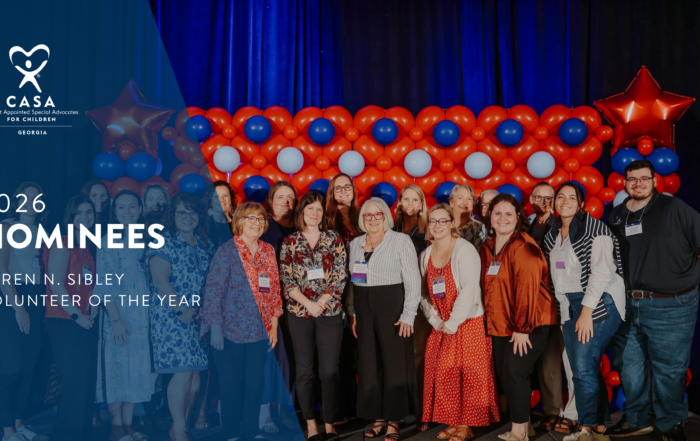
CASA volunteers are everyday people with a special heart to serve the best interests of children experiencing foster care. In Georgia, thousands of amazing CASA volunteers serve children and families in crisis every day. One way we honor and acknowledge this exceptional work is through our annual Awards of Excellence. Volunteers are nominated by local CASA programs for our annual Karen N. Sibley CASA Volunteer of Year Award and the recipient is honored at the Annual Conference Luncheon every August. Let's meet this year's nominees for Volunteer of the Year!
Meet 2025 Volunteer of the Year Nominees!
CASA volunteers are everyday people with a special heart to serve the best interests of children experiencing foster care. In Georgia, thousands of amazing CASA volunteers serve children and families in crisis every day. One way we honor and acknowledge this exceptional work is through our annual Awards of Excellence. Volunteers are nominated by local CASA programs for our annual Karen N. Sibley CASA Volunteer of Year Award and the recipient is honored at the Annual Conference Luncheon every August. Let's meet this year's nominees for Volunteer of the Year!