Found Family
By Miriam Wade
Since leaving college and building my career within the child welfare landscape, I’ve realized how deeply the idea “found family” connects to the experiences of many children in foster care.
“Found family” is a concept that redefines family as non-biological and intentional and is a foundation in the LGBTQ+ community. It involves defining what family is for oneself, building genuine connections with people who are supportive through thick and thin and offer safe spaces to be oneself completely. Many youth and adults in the LGBTQ+ community have had to search for belonging, looking for spaces where they can just be without fear of rejection or misunderstanding. Because of these relational traumas, people in the LGBTQ+ community search for just that – community.
Growing up, I understood family as something fixed, something strictly set in stone and indisputable. “Blood is thicker than water” was said from a lens of both comfort and expectation, stated as though the people we are born to are automatically the people who will know us best, protect us most fiercely, or love us most completely. As I moved away and started to find people who saw me clearly – people who guided me, protected me, advocated for me, and created spaces where I could exist safely and honestly – the more I began to realize that family is not pre-determined by DNA, but can be something we build. The more family I find around me, the easier it becomes to understand and accept myself as a queer person.
Every child in foster care deserves that kind of safety. Every child deserves adults who advocate not only for their physical needs but also for their identity, individuality, and joy. Reunification is still the goal whenever safely possible, but creating a safe community along the way can ease the journey, and CASA volunteers can be a major part of creating that improvement. Children with specialized needs deserve environments where accommodations are not treated as inconveniences, but as acts of care and respect. Youth identifying as LGBTQ+ deserve safety and room to grow. All children deserve spaces where they do not have to question whether they are too much, too different, or too difficult to love. That is the heart of being a trusted person in a child’s life. That is the heart of advocacy. That is the heart of found family.
Most children and youth experiencing foster care experience instability, uncertainty, and disruption to their families. So many search for consistency, safety, and belonging, searching for adults who will listen carefully, show up reliably, and make them feel worthy of care simply because they exist. Youth identifying as LGBTQ+ and children with specialized needs often have to navigate spaces that were not built with their needs in mind and may carry additional layers of uncertainty and fear, especially if they have experienced rejection, instability, or environments where they could not safely be themselves.
That’s why becoming a trusted adult as a CASA volunteer matters so much.
Trust is not automatic. It cannot be demanded. Children who have experienced instability often learn to test adults, and they quickly notice inconsistencies. They learn to protect themselves carefully and test trust before they believe it. Trust can be built slowly through our advocacy and the way we show up. Sometimes advocacy is formal like attending court, speaking up in meetings, or making recommendations for services they deserve. But sometimes advocacy looks smaller and softer. It’s remembering a child’s favorite snack, respecting their identity without hesitation, listening to and learning from them, or following through on a promise when they expected disappointment instead. Trust is built in those quiet, smaller moments. Advocacy begins with becoming a trusted person: someone who listens, someone who makes a child feel seen, someone who stays.
They say that “blood is thicker than water,” but it is also true that water is needed for something to grow. It is needed to help adapt, soften, and sustain life. As a queer adult, I think a lot about the people who made space for me to become myself safely. The people who reminded me, directly or indirectly, that I did not have to shrink to be accepted. Pride Month celebrates visibility and authenticity, but pride is also deeply connected to community. None of us becomes who we are entirely alone. We grow through connection. Through affirmation. Through people who help us believe that we are worthy of being seen fully and loved honestly. Not just understanding us, but embracing our belonging.
Sometimes that belonging comes from lifelong friendships forged from the beginning. Sometimes it comes from partners, coworkers, mentors, or neighbors. Sometimes it comes from the quiet comfort of someone remembering who you are and making it clear that you are safe with them. Found family, pride, and advocacy all ask the same things of us in the end — presence, empathy, and compassion.
As an organization dedicated to supporting children and families in crisis, we recognize that holidays can be a delicate and nuanced time for many. In this series, Purposeful Perspectives, we asked our staff and board members to select a season, month, or day that is meaningful to them to share with our CASA community. Thank you for joining us as we take a deeper look behind the celebrations that fill our lives.
Featured Posts
Advocacy in Action: Seeing the Whole Family to Serve the Child
"One of the greatest rewards of being a CASA volunteer comes long after the court hearings have ended, and the case has been closed. Occasionally, a text message, photograph, or email arrives unexpectedly. It may be a picture of a child smiling on the first day of school, celebrating a birthday, earning an award, or simply enjoying life with family. Those moments are powerful reminders that our work extends beyond court reports and recommendations. They remind us that the relationships we build and the advocacy we provide can have a lasting impact on a child's life."
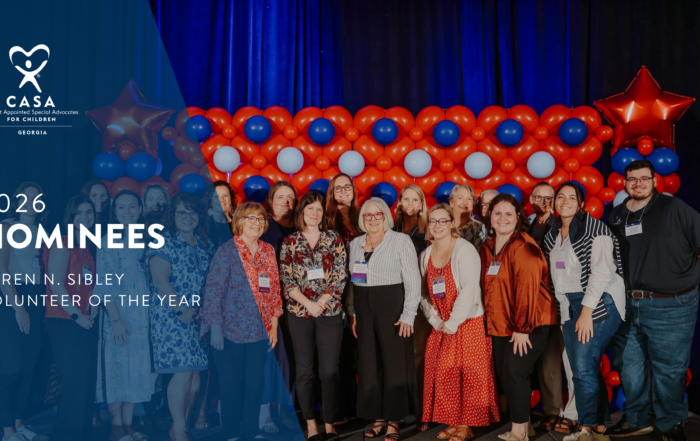
Meet 2026 Volunteer of the Year Nominees!
CASA volunteers are everyday people with a special heart to serve the best interests of children experiencing foster care. In Georgia, thousands of amazing CASA volunteers serve children and families in crisis every day. One way we honor and acknowledge this exceptional work is through our annual Awards of Excellence. Volunteers are nominated by local CASA programs for our annual Karen N. Sibley CASA Volunteer of Year Award and the recipient is honored at the Annual Conference Luncheon every August. Let's meet this year's nominees for Volunteer of the Year!
Meet 2025 Volunteer of the Year Nominees!
CASA volunteers are everyday people with a special heart to serve the best interests of children experiencing foster care. In Georgia, thousands of amazing CASA volunteers serve children and families in crisis every day. One way we honor and acknowledge this exceptional work is through our annual Awards of Excellence. Volunteers are nominated by local CASA programs for our annual Karen N. Sibley CASA Volunteer of Year Award and the recipient is honored at the Annual Conference Luncheon every August. Let's meet this year's nominees for Volunteer of the Year!